
About the Society
Our History
In 1923, a group of chamber music enthusiasts formed a society to continue the series of Tuesday Mid-Day Concerts which had been started in 1915 during the First World War. Needing a new management for the series, they appointed Edward Isaacs as Director of Concerts, and he devised the format that has kept the concert series going for over one hundred years. Despite several changes in name, venue and concert days, the principles on which the concerts series was founded remain very much in place.
The First World War and early years (1915 – 1923)
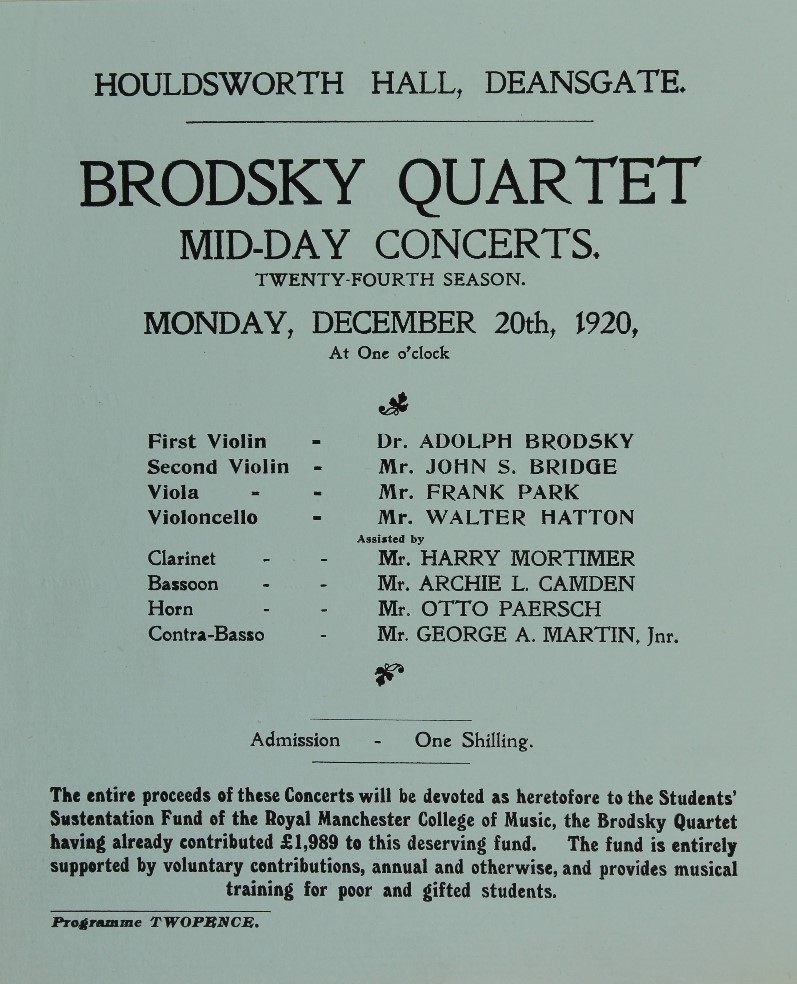
In 1915, the Committee for Music in Wartime (Northern Section) started a series of lunchtime concerts in Manchester, the first being held on 9 November that year. The purpose was to raise money to provide musical entertainment in military hospitals. With no government grants to call upon, the charity had to be self-financing. When they began, the concerts, which lasted forty minutes, were held at the Houldsworth Hall on Deansgate under the directorship of William Eller. The first twelve were called ‘Tuesday Popular Concerts’; thereafter they were known as ‘Tuesday Mid-Day Concerts’. Following on from their success, a Friday noon series of concerts was started, with Edward Isaacs as Director. The Friday series raised money for Music at the Front, another charity.
Sydney Nicholson, then organist of Manchester Cathedral, was a prominent member of the committee. He was responsible for organising up to eighty concerts a week in military hospitals in the area covered by the northern section of the committee. Several of his works were performed at the Tuesday Mid-Day Concerts, including a piano quintet in E major at the 147th concert, on 26 November 1918. As well as the money-raising and morale-boosting rationale for the concerts, some of the committee members, including William Eller, the Director of Concerts, regarded them as a way of providing employment for musicians in difficult times.
The Manchester Tuesday Mid-day Concerts Society (1923 – 1972)
By the end of the war, the concerts were well established, and both the Tuesday and Friday series continued. At this point, Tuesday Mid-Day Concerts were held in more than forty weeks of the year. However, audiences began to decline after the war, and by 1923 the committee found itself out of pocket. The decision was made to form a society which would charge annual subscriptions, to be channelled towards reducing the deficit. Thus, the Manchester Tuesday Mid-Day Concerts Society was born, under the chairmanship of William Eller. It was lucky to secure the services of Edward Isaacs as Director of Concerts, and his personality shaped the society in a way that has enabled it to survive to the present day. As he began to lose his sight in 1925, Isaacs summarised in minute detail, in written form, the procedures for running the concert series. He collated examples of letters to be sent in connection with organising auditions and contracts to be issued to performers, instructions on the printing of programmes and tickets, details of front-of-house duties in the hall on concert days, and so on: a real quality control strategy years before it became fashionable in industry.
The society planned to continue the series of over forty concerts a year with a mixture of celebrity artists and newcomers. The encouragement of the latter had been part of the policy of the concerts from the beginning, and in the early days the Director had approached young artists who he thought might be suitable. This had led to occasional problems, so Isaacs instituted the system of auditions, held in London and Manchester. The archive of audition reports makes fascinating reading, even if only at the inquisitive level of ‘Did the auditor get it right?’. The society stuck to its policy of encouraging young performers, despite the lack of enthusiasm displayed by some of the funding bodies to whom applications for grants were made.
The concerts struggled constantly to find a permanent home. Concert hall owners did not like their premises being rented for only a couple of hours at lunchtime, which meant that more profitable whole day rents had to be forgone. Over the years, the audience loyally followed the concerts from venue to venue. The suitable halls available in Manchester in the 1920s were the Houldsworth Hall on Deansgate, the Albert Hall on Peter Street, the Lesser Free Trade Hall, St Ann’s Church, the Memorial Hall in Albert Square, and the Friends’ Meeting House. None of them was ideal, but the society did the best it could.
The piano owned by the society was usually kept at the Houldsworth Hall and moved between locations as required. At the Albert Hall, with its steep flight of stairs, eight men were needed to move the instrument.
The list of artists who appeared early in their careers in the Tuesday Mid-Day Concerts and went on to make a name for themselves internationally is a long one. Edward Isaacs actively encouraged a number of performers, pianists like himself, among whom may be mentioned Myra Hess, Eileen Joyce, Moura Lympany, Cyril Smith and Phyllis Sellick. Thanks to the mix of celebrity artists and newcomers, the Tuesday Mid-Day Concerts played an important role in the musical life of Manchester and the wider world.
From its inception in 1923 the society enjoyed an association with the BBC. The society would draw up a list of artists it wanted to promote, from which the BBC would select a small number. During the Second World War, broadcasting of the concerts was suspended, resuming in 1953. By the 1960s the BBC wanted to broadcast on Thursdays instead of Tuesdays. After much debate, the society gave way. By this time, only twenty four concerts were being promoted each year: twelve on Tuesdays and twelve on Thursdays. By 1970, all the concerts were on Thursday, and the society’s name had become an anachronism.
The Manchester Mid-day Concerts Society (1972 -2025)
In 1972 the charity name was shortened to The Manchester Mid-Day Concerts Society, reflecting that concerts no longer took place on Tuesdays. Still promoting about twenty concerts a year, the majority of artists were young emerging musicians selected through the audition process. Concerts could take place on any weekday reflecting the pressure to get suitable performance space at a lunchtime. The permanent venue for all concerts is now in the main hall of The Bridgewater Hall in Manchester.
Manchester Midday Music 2025 to the current day
In 2025 the Trustees decided to create a new brand for the Charity, still reflecting our heritage but also recognising our need to develop and move forward, and so Manchester Midday Music was created. The Charity now plans to run a number of other projects in addition to the concert series focusing on its mission to provide opportunities for development to young musicians and those starting out in a career in music.
Further work is being undertaken on examining our archives and documenting our history. As this is completed, we will publish more information here.
Our History taken from “The Manchester Tuesday Mid-day Concerts Society, 1923 -1972” (abridged) written by Antony Sluce for Manchester Sounds 2003-4, the journal of The Manchester Musical Heritage Trust. Antony was Chair of the Society from 1998 to 2003 and remains a Trustee of the Charity to this day.
Our Trustees
David Atherton | Karen Humphreys | David Jones | Bill Lam | Richard Martindale |
Christa Norton | Hazel Parker | Andrew Tabron (Treasurer) | Antony Sluce |
Catherine Webb (Chair)
Support Manchester Midday Music
Join us as a Friend and support Manchester’s musical heritage and artists at the beginning of their careers.
Benefits include:
- Free concert vouchers
- Complimentary tickets to our annual reception and sponsored concert
- Opportunities to to get involved in the work of the Charity
- Our thanks recorded in the season brochure and the website (if desired)
- The knowledge that you’re supporting Manchester’s musical heritage and artists at the beginning of their music careers
Our Friends Membership begins from £50 a year with many more opportunities available to support specific concerts or outreach work. Contact Us and join one of our membership schemes.
Become a Sponsor of Manchester Midday Music
- Showcasing your brand to new audiences
- Increased profile by reaching audience members and readers of our season brochure
- Client Entertainment opportunities before and after the concert
- Business Development Opportunities
- Increased Employee Engagement